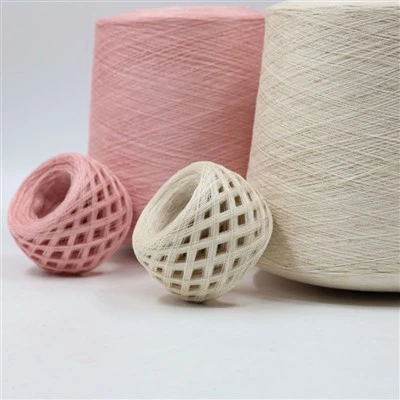
As a seasoned blended yarn supplier, I’ve witnessed firsthand the evolution and diversity of production methods in the textile industry. Blended yarn, a combination of two or more different types of fibers, offers a unique set of properties that can enhance the performance, comfort, and aesthetic appeal of textiles. In this blog post, I’ll share some of the most common production methods of blended yarn, providing insights into the process and the benefits each method brings. Blended Yarn
1. Fiber Mixing at the Blowroom Stage
One of the most straightforward and commonly used methods for producing blended yarn is fiber mixing at the blowroom stage. This method involves combining different types of fibers right at the beginning of the textile production process.
The blowroom is the first stage in spinning, where raw fibers are opened, cleaned, and blended. The process starts by weighing and measuring the different fibers according to the desired blend ratio. For example, if we want to create a blended yarn with 60% cotton and 40% polyester, we’ll measure out the appropriate quantities of each fiber.
Once the fibers are measured, they are fed into the blowroom machinery. The blowroom machines use a series of beater bars and air currents to open the compressed bales of fibers, remove any impurities such as dirt, seeds, and short fibers, and thoroughly mix the different fiber types. This thorough mixing ensures a uniform distribution of fibers throughout the blend, which is crucial for producing high – quality yarn.
The advantage of fiber mixing at the blowroom stage is that it allows for a very homogeneous blend. Since the fibers are mixed at such an early stage, the resulting yarn has consistent properties throughout its length. This method is particularly suitable for blends where a high degree of uniformity is required, such as in fine – quality apparel.
2. Sliver Blending
Sliver blending is another popular method for producing blended yarn. In this process, the blending occurs at the sliver stage, after the fibers have been carded.
Carding is a process where fibers are separated into individual strands and aligned in a parallel fashion to form a continuous web of fibers, which is then condensed into a loose rope – like structure called a sliver. In sliver blending, we first produce individual slivers of different fiber types using separate carding machines.
For example, we might produce a cotton sliver and a polyester sliver. These slivers are then fed into a draw frame, which is a machine that combines multiple slivers into one. The draw frame pulls the slivers through a series of rollers, stretching and doubling them several times. This action not only blends the different fiber slivers together but also further aligns the fibers and reduces the sliver thickness to the desired level.
The main benefit of sliver blending is its flexibility. It allows for easy adjustment of the blend ratio, as we can simply change the number and weight of the slivers being fed into the draw frame. This method is also useful when dealing with fibers that are difficult to blend at the blowroom stage, such as some high – performance or specialty fibers.
3. Roving Blending
Roving blending takes place after the sliver has been further processed into a roving. A roving is a thin rope of fibers that is slightly twisted to hold the fibers together.
In roving blending, we produce individual rovings of different fiber types. These rovings are then combined and twisted together to form a blended roving. This can be done on a special roving – blending machine or by modifying a regular spinning frame.
During the roving – blending process, the rovings are carefully guided and fed into the machine to ensure a uniform twist and distribution of the different fiber types. The blended roving is then further spun into yarn on a spinning machine.
Roving blending offers more control over the final yarn structure. By blending at the roving stage, we can create unique yarns with specific properties, such as a yarn with a different surface texture or a yarn that has a gradient of fiber distribution. This method is often used in the production of novelty or high – end yarns.
4. Yarn – on – Yarn Blending
Yarn – on – yarn blending, also known as ply blending, involves combining pre – spun single yarns of different fiber types or compositions.
The process is relatively simple. Two or more single yarns are twisted together to form a plied yarn. For example, we might take a single cotton yarn and a single polyester yarn and ply them together. This can be done using a plying machine, which twists the yarns around each other in a controlled manner.
The advantage of yarn – on – yarn blending is that it allows us to combine the unique properties of different pre – spun yarns. For instance, we can combine a soft and absorbent cotton yarn with a strong and durable polyester yarn to create a blended yarn that has both comfort and performance characteristics. This method is also useful for creating yarns with a specific appearance, such as a heathered or multi – colored effect.
5. Solution Blending (for Synthetic Fibers)
Solution blending is a specialized method used primarily for synthetic fibers. In this process, polymers that will form the fibers are blended at the solution stage.
First, the different polymers are dissolved in appropriate solvents to form polymer solutions. These solutions are then mixed together in a specific ratio. The mixed solution is then extruded through spinnerets, which are small holes that form the fibers as the solution is forced through them. As the solvent evaporates or is removed, the fibers solidify, resulting in a blended synthetic fiber.
Solution blending offers precise control over the blend composition at the molecular level. This can lead to fibers with unique and enhanced properties, such as improved strength, elasticity, or resistance to chemicals. However, this method requires specialized equipment and careful handling of solvents, which can make it more expensive and complex compared to other blending methods.
Why Choose Our Blended Yarn?
As a supplier of blended yarn, we leverage these production methods to offer high – quality products that meet the diverse needs of our customers. Our commitment to using the latest technology and best practices ensures that our blended yarns have consistent quality, excellent performance, and a wide range of colors and textures.

Whether you’re in the apparel industry looking for comfortable and stylish yarns, the home textile sector in need of durable and soft materials, or the technical textile field requiring high – performance fibers, our blended yarns are the ideal choice. We can customize the blend ratio, fiber types, and production methods according to your specific requirements, ensuring that you get the perfect product for your application.
Blended Yarn If you’re interested in learning more about our blended yarn products or would like to discuss a potential purchase, we encourage you to reach out to us. Our team of experts is ready to provide you with detailed information, samples, and pricing. We believe in building long – term partnerships with our customers, and we’re confident that our blended yarns will exceed your expectations.
References
- Morton, W. E., & Hearle, J. W. S. (1993). Physical Properties of Textile Fibres. Woodhead Publishing.
- Horrocks, A. R., & Anand, S. C. (2000). Fire Retardant Textiles. Woodhead Publishing.
- Postle, R. (1996). Innovation in Textile Manufacturing Technology. Woodhead Publishing.
Dongguan Jintai Textile Technology Co., Ltd.
As one of the most professional blended yarn manufacturers and suppliers in China, we offer a wide range of products with superior quality. With abundant experience, we warmly welcome you to wholesale high quality blended yarn in stock here and get free sample from our factory. We also accept customized orders.
Address: No. 22 Fukang Road, Dalang, Dalang Town, Dongguan City, Guangdong Province
E-mail: 13553898187@163.com
WebSite: https://www.jintaitextile.com/
