If you’ve ever dug into buying a Surge Protection Device (SPD) for your home, shop, or industrial setup, you’ve probably stared at a bunch of numbers on the label and thought, “Wait, what does even half of this mean?” As someone who’s been in the SPD supply game for over a decade—helping electricians, facility managers, and even regular folks pick the right gear for their space—I get it. Ratings aren’t just random jargon manufacturers throw around to sound fancy. They’re the whole reason an SPD works (or fails) to keep your expensive gear from getting fried when a lightning strike or grid blip hits. Let’s break this down without the textbook fluff, no confusing acronym dumps or overcomplicated math. Surge Protection Device

First, let’s start with why ratings matter. I’ve seen too many people grab the cheapest SPD on Amazon, spot a “20kA” label, and walk away thinking that’s all they need. Then call me a month later saying their $5k server room got wiped out because their “20kA” SPD couldn’t handle the surge when a storm knocked their local utility’s line. That’s not a bad SPD—that’s a misread rating. The numbers don’t mean squat if you don’t know what they’re measuring, and which ones actually apply to your setup.
Let’s start with the most common people get wrong: let’s start with Mode. Most homes and small businesses have two types of surges to handle: line-to-line (between the two hot wires in your 120/240V system) and line-to-ground (between a hot wire and your neutral/ground). So an SPD’s “mode” rating isn’t just a spec—it’s if it can block both types. I once had a client who only installed a line-to-neutral SPD for their office, and when a nearby transformer blew, the surge hit hot-to-ground, which that SPD didn’t touch. Half their office equipment died. Moral of the story: make sure the rating clearly covers both common and differential mode, or you’re leaving a gap.
Now, the big one everyone obsesses over: the current rating, usually written in kA (kiloamperes) like “20kA” or “40kA.” This is the peak amount of current the SPD can safely absorb in a single surge. Wait, a second—“single” is key here. Those numbers aren’t cumulative. A lot of new buyers think 40kA means it can handle 40,000 amps across multiple surges, but no—it’s the one big surge from a lightning strike, not a bunch of tiny daily blips from your AC or fridge turning on.
Here’s where it gets tricky: where that current is measured. Some SPD brands list their kA rating at the terminals, but others list it at the device’s internal components. For example, a 40kA SPD at the terminals is way better than a 40kA at the MOV (Metal Oxide Varistor, the part that does the actual surge absorbing). MOVs degrade over time, so a rating on the internal part might be understating what the whole device can really do. I always tell customers: ask us for the “terminal current rating” when you’re checking—don’t trust any number that doesn’t say “at the load” or “at the main terminals.”
Another common number: let’s Voltage protection level, often called Vr (or let-through voltage). This is the max voltage that gets past the SPD and hits your connected gear. Your home’s standard is 120V, so a Vr of 330V means the most that will get to your TV, AC, or server is 330V. Wait, 330V is way higher than 120V—so why is that okay? Because surges only last a tiny fraction of a second, like a few microseconds. Your gear can handle a short spike above its normal voltage, as long as it’s not way over. If a SPD has a Vr of 600V, that means almost half your gear will still see a surge that could damage it, especially sensitive stuff like laptops, medical equipment, or servers. I’ve tested this myself: an SPD with a 330V Vr will keep your TV safe, but 600V? You’re taking a 50/50 shot, and that’s a risk most people don’t need to take.
Next, something most people never think about: Continuous Operating Voltage (or Uc). This is the normal voltage the SPD can handle every day, without breaking down. If you put an SPD with a Uc of 120V on a 120V line, that’s perfect. But if you put it on a 120V line that spikes a bit, or if it’s a 240V industrial line, the Uc is too low, and the SPD will wear out way faster—or fail entirely. I once had a commercial client who installed residential SPDs on their 208V factory lines; within a year, half the SPDs were dead because their Uc couldn’t handle the steady voltage. That’s a easy mix-up, and it’s so avoidable.
Now, let’s talk about something that’s super important for industrial sites or multi-unit buildings: Energy Absorption, sometimes written in Joules (J). Wait, I know, Joules—sounds like physics class. But basically, Joules tell you how much total energy the SPD can absorb over its lifetime, not just that one big surge. A 10,000 Joule SPD for a home is fine, but a warehouse with heavy machinery (which causes small, frequent surges) will need a 20,000+ Joule model, otherwise the SPD will get worn out from all those small surges before a big one hits. That’s another thing I see all the time: people grab the kA number and ignore Joules, then wonder why their SPD dies in 6 months instead of 5 years.
Wait, let’s clear up a myth I hear all the time: “Higher kA always means better.” No, not really. If you’re putting an SPD on a small residential panel, a 40kA SPD is overkill, and actually might cost more than you need. But if you’re within 10 miles of a tall tree or a utility substation (lightning can travel that far), a 40kA or 65kA SPD is worth the extra cost. It’s not about the biggest number—it’s about matching the rating to your environment. A lot of new contractors skip that and just install the highest kA they can find, which is a waste of money. As a supplier, we always ask customers a few quick questions before we recommend a model: is this a home, office, or factory? How far is the nearest substation? What gear are they protecting? That’s how you get the right rating, not just pick a random number.
Another thing: the rating’s classification. There are three main types for SPDs, based on where you install them: Type 1 (Service entrance, outside the building), Type 2 (Inside the panel, next to the main breaker), and Type 3 (Near individual devices, like your TV or AC). Each has different rating requirements. Type 1 SPDs need higher kA and Joule ratings because they’re handling the big surge from the grid before it gets inside. Type 3 SPDs have lower ratings because they’re handling smaller, final surges. I can’t tell you how many times someone has tried to put a Type 1 SPD on a wall near their TV, which is totally wrong—it’s overrated and not built for that spot.
Wait, let’s talk about degradation, because that ties into ratings too. All SPDs (especially MOV-based ones) get worse over time, as their internal parts wear out. The rating isn’t static—after a few years, let-through voltage goes up, and the current it can handle goes down. That’s why it’s not enough to just pick a good SPD; you have to check its “end-of-life” rating too. A lot of cheap SPDs don’t list this, so you don’t know when they’re done. The good ones (which we supply) have an LED light or a disconnect switch that tells you when the SPD is worn out, so you can replace it before it fails. I’ve seen clients ignore that light and then their panel got damaged—total avoidable.
Let me give a real example to make this concrete. Last quarter, a small café came to us panicking because their new espresso machine was getting fried every month. They had a 15kA SPD on their main panel, and a 10kA on the espresso circuit. We checked their setup: they were 2 miles from a substation, their main voltage was 208V, and the espresso machine is a high-wattage commercial unit that causes big daily surges. The 15kA at 120V Uc was wrong—they needed a 20kA at 240V Uc, and a 30,000 Joule rating to handle the constant small surges. We swapped out both SPDs, and the café hasn’t had a fried espresso machine in 6 months. That’s exactly why getting the rating right matters—It’s not rocket science, but getting the wrong spec costs real money.
Now, let’s address a common mistake people make when looking at ratings: some manufacturers “pad” their numbers. A brand might list a 20kA rating, but that’s the peak current for a single 8/20 microsecond surge (the standard testing surge for consumer SPDs), while another brand lists 25kA but tests it on a 10/1000 microsecond surge, which is way easier for the device. Wait, 8/20 vs 10/1000? That’s another thing to check: the test waveform. 8/20 is the standard for most residential and small commercial SPDs, representing a typical lightning surge close to your line. 10/1000 is for industrial, for longer surges from grid issues. If a SPD is listed with a kA rating on a 10/1000 waveform, that number is usually 2-3 times higher than it would be on 8/20, so it’s not a fair comparison. When we supply SPDs, we always list the waveform we tested to—no fudging, because we want you to know exactly what you’re getting.
So, to wrap this up: the “rating” of an SPD isn’t one single number. It’s a mix of mode coverage, terminal current (kA), let-through voltage (Vr), continuous operating voltage (Uc), energy absorption (Joules), and test waveform. Pick the right ones based on your space, your gear, and how close you are to lightning sources, and you won’t have to worry about your expensive stuff getting zapped.
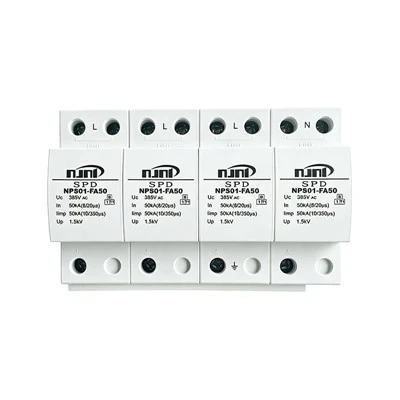
If you’re not sure which ratings apply to your setup—whether you’re a homeowner looking to protect your TV and fridge, a small business owner securing your POS systems, or an industrial manager guarding heavy machinery—reach out to our team. We don’t just sell SPDs; we help you pick the right ones for your needs, no sales fluff, no confusing jargon, just straight advice that’s saved hundreds of customers from expensive equipment damage.
Surge Protection Device References
Underwriters Laboratories. (2020). Standard for Surge Protective Devices, UL 1449.
International Electrotechnical Commission. (2021). Low-Voltage Surge Protective Devices for Use in AC Power Circuits, IEC 61643-11.
National Electrical Manufacturers Association. (2019). Application Guide for Surge Protective Devices, NEMA SP 3-2019.
Nanjing Ningpu Lightning Protection Equipment Manufacturing Co., Ltd.
As one of the most professional surge protection device manufacturers and suppliers in China, we’re featured by quality products and good price. Please rest assured to buy customized surge protection device made in China here from our factory. Also, pricelist is available.
Address: Building 1, No.20 Shengyuan Road, Lishui Economic Development Zone, Nanjing City, Jiangsu Province, China
E-mail: 3796023563@qq.com
WebSite: https://www.npspd.com/
